NanoSWIM ARVAND-O3 Wellboat Disinfection with Ozone Nanobubbles
Ozone-nanobubble disinfection for wellboats — closed loop, monitored and verified.
- Closed-loop disinfection between assignments
- Ozone destruct unit on the vent, residual ozone removed before discharge
- Duty and standby pumps, ozone gas detection, automatic shutdown
- Logged ORP / TRO data for documentation
Technical Specifications
| Duty | Closed-loop disinfection of wells, piping and equipment between assignments |
|---|---|
| Ozone generation | Three ozone generators (O3-201A/B/C) fed with oxygen, on an ozone gas manifold |
| Nanobubble reactor | NB-201 |
| Static mixer | MX-201 |
| Degassing separator | DG-201 |
| Deozonation cartridge | DZ-201, before discharge |
| Ozone destruct unit | ODU-201, on the vent (off-gas control) |
| Pumps | Duty and standby (P-201A / P-201B) |
| Seawater inlet | With seawater strainer (STR-201) |
| Safety | Ozone gas detection, automatic safety shutdown, emergency stop, stack light |
| Control | PLC / HMI control cabinet |
| Monitoring | ORP and TRO (TRO measured in seawater), continuous logging |
| Frame | Stainless steel |
| Footprint | Approx. 2.0 m × 2.0 m |
| Capacity | Sized per vessel — no fixed rating is published |
How It Works
-
1
Make ozone, dissolve it as nanobubbles
Three oxygen-fed ozone generators supply the nanobubble reactor, which puts the ozone into seawater as nanobubbles.
-
2
Circulate through the empty wells
The empty wells, piping and equipment are treated in a closed loop between assignments, with ORP and TRO monitored against a defined exposure time.
-
3
Remove the ozone, verify, reuse
Off-gas goes through the ozone destruct unit, residual ozone is removed in a deozonation cartridge before discharge, and safe conditions are verified before the system is used again.
You May Also Like
What is the ARVAND-O3 for?
The ARVAND-O3 is NanoSWIM's skid for wellboat disinfection: it disinfects a wellboat's wells, piping and associated equipment in a closed loop between assignments — after unloading and before the next loading. It is intended for planned technical disinfection between transfer operations and for controlled system hygiene. It is not a treatment for water with fish on board.
The problem it is aimed at has four parts:
- Pathogen transfer between loads and between regions.
- Downtime — washing, disinfection and verification take hours to a day, or more, of vessel time per turnaround.
- Chemical handling and discharge — handling complexity, crew safety and environmental pressure.
- Uneven treatment — UV or standard loop treatment often disinfects the circuit but not the full body of water inside the well.
How disinfection and oxygenation fit together on one vessel is on wellboat solutions.
How does it relate to NanoOzone?
The ARVAND-O3 is the skid form of NanoSWIM's existing NanoOzone approach, built for a wellboat. The chemistry is the same: ozone is a strong oxidiser that reverts to oxygen and leaves no lasting by-product. The difference is packaging — generators, reactor, pumps, safety and control on one stainless-steel frame, designed for a vessel.
The process chain is: ozone generator → nanobubble generator → recirculation loop → wellboat tanks → ORP / TRO monitoring → off-gas control.
Why deliver ozone as nanobubbles at all? This is the design rationale, and it should be read as that:
- bubbles under 200 nm stay suspended instead of rising and bursting;
- the aim is higher gas-transfer efficiency, so less ozone is wasted and less off-gas is produced;
- longer effective contact time, and better reach into tanks, piping and hard-to-reach zones;
- an oxidative effect in the water body inside the well, not only in the technical room;
- reactive oxygen species formed when bubbles collapse can enhance microbial inactivation and attack biofilm.
How nanobubble ozone compares with conventional injection is on nanobubbles vs conventional ozone.
What is on the skid?
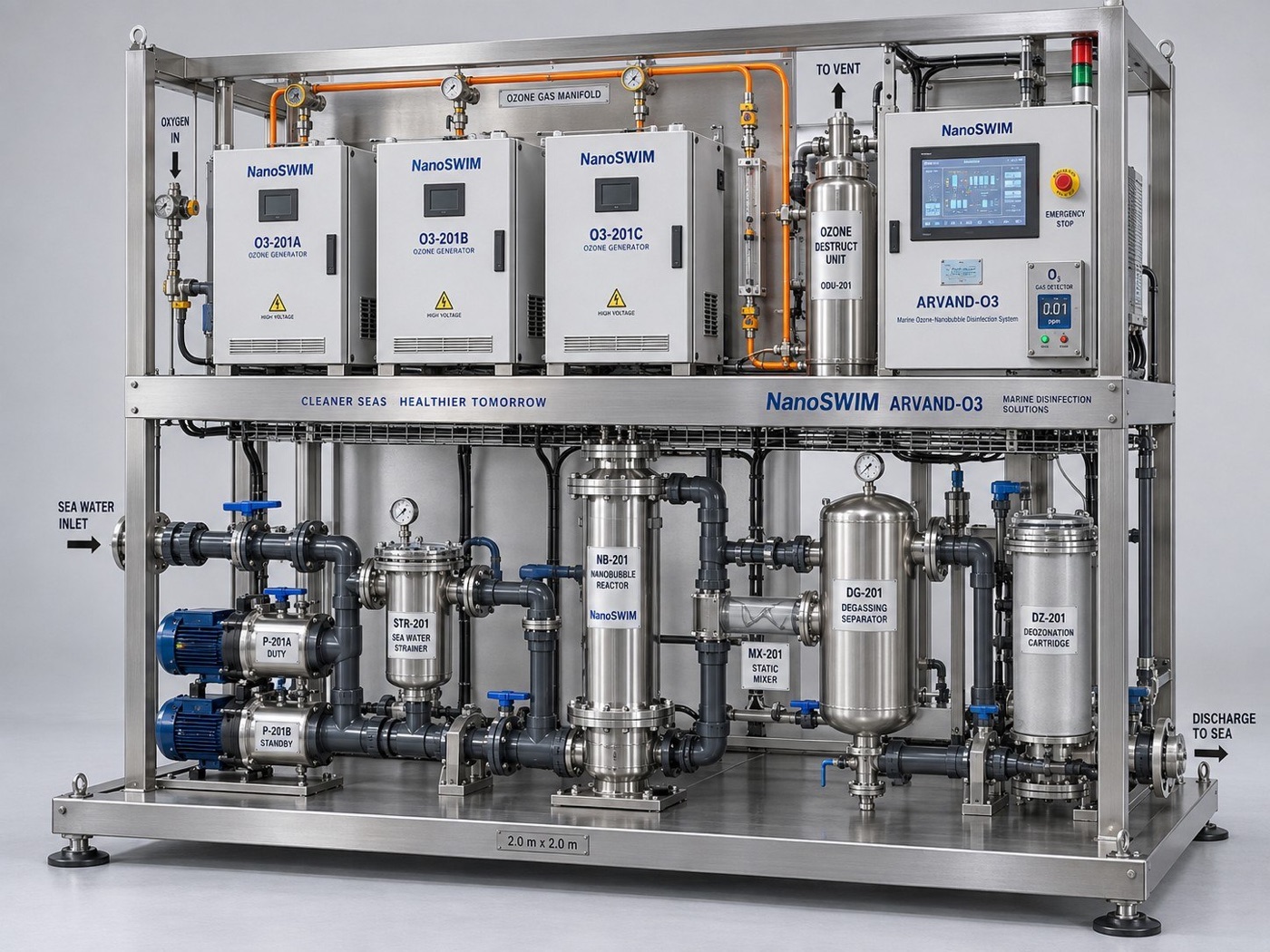
As drawn on the render, oxygen feeds three ozone generators on a common ozone gas manifold. Seawater enters through a strainer and is moved by a duty pump with a standby pump behind it. The ozone goes into the water in the nanobubble reactor; a static mixer and a degassing separator are also on the skid. Gas vented from the system passes an ozone destruct unit, and treated water passes a deozonation cartridge before it is discharged, so it does not leave with residual ozone in it. The final configuration is set per vessel.
Ozone is hazardous to breathe. That is why an ozone gas detector, automatic shutdown, an emergency stop and a stack light are part of the skid, alongside the PLC / HMI control cabinet. The footprint is about 2.0 m × 2.0 m. The tagged components are listed in the table below.
How does wellboat disinfection with the ARVAND-O3 run?
The control parameters are ORP, TRO measured in seawater, a defined exposure time, off-gas management and automatic safety shutdown. ORP and TRO are logged continuously, so each disinfection leaves a record that can be used for verification and documentation. What a buyer should ask any supplier to document is on standards and compliance.
- Prepare and isolate the system.
- Start closed-loop circulation.
- Activate the NanoOzone treatment.
- Monitor ORP / TRO and contact time.
- Verify safe conditions before reuse.
How does it compare with UV and chemical dosing?
Each existing method has a known weak point. UV treats water only as it passes the unit, has no residual effect inside the well, and has limited effect in dead zones and complex piping — see nanobubbles vs UV. Chemical dosing carries a handling and safety burden, chemical cost and discharge concerns, possible corrosion and more crew work. Standard ozone with ordinary bubbles transfers gas less efficiently, off-gasses more and wastes ozone, and takes longer to reach the target ORP / TRO.
The ARVAND-O3 is designed to address those points. Whether it does so on your vessel, and by how much, is exactly what a pilot measures.
What is not yet proven
The ARVAND-O3 image is a render of the skid architecture, not a photo of an installed system, and this page describes what is on the skid rather than how it performs. NanoSWIM publishes no capacity, ozone output or flow figure for it, because it is sized per vessel.
Wellboat disinfection systems are offered through a pilot programme. The pilot has a target — to cut disinfection turnaround by at least 50% while improving biosecurity control. That is a target, not a result, and no vessel has yet reported it.
- It is not for use with fish on board. Oxygenation during transport is a different job — see NanoSWIM ABAN-20.
- It does not remove the need for verification. Checking safe conditions before reuse is a step in the workflow, not an option.
- It needs an integration study first. Tank volume, circulation loop, hygiene protocol and integration points decide the configuration.
| Tag | Component | What it does |
|---|---|---|
| O3-201A / B / C | Ozone generators (three), oxygen-fed | Produce ozone gas onto a common ozone gas manifold |
| NB-201 | Nanobubble reactor | Puts the ozone into the seawater as nanobubbles |
| MX-201 | Static mixer | Mixes the ozonated stream |
| DG-201 | Degassing separator | Separates gas that has not dissolved |
| ODU-201 | Ozone destruct unit | Destroys ozone in the vent gas (off-gas control) |
| DZ-201 | Deozonation cartridge | Removes residual ozone before the water is discharged |
| P-201A / P-201B | Seawater pumps, duty and standby | Circulation, with a standby pump in reserve |
| STR-201 | Seawater strainer | Protects the skid at the seawater inlet |
Also on the skid: ozone gas detector, PLC / HMI control cabinet, emergency stop and stack light, on a stainless-steel frame of about 2.0 m × 2.0 m. Tags are from the render; the final configuration is set per vessel.
How a pilot runs — and how to value it
The value is simple to estimate with your own numbers: value per turnaround = hours saved ÷ 24 × the vessel's day rate. Multiply by turnarounds per year, then add any saving on chemicals and handling. Put in your own day rate and your own turnaround count — the pilot is what tells you the hours saved. Talk to us about a pilot.
- Vessel assessment — tank volume, circulation loop, hygiene protocol and integration points.
- Concept design — ozone, nanobubble, monitoring and off-gas configuration.
- Pilot on board — disinfection trials between assignments, in closed-loop mode.
- Measure results — ORP / TRO, turnaround time, chemical reduction and operational savings.
- Scale deployment — additional vessels, with service and monitoring support.
Frequently asked questions
Can the ARVAND-O3 be used with fish on board a wellboat?
What capacity does the ARVAND-O3 have?
How does the ARVAND-O3 deal with residual ozone?
How is disinfection with the ARVAND-O3 verified?
How much turnaround time does the ARVAND-O3 save?
How is the ARVAND-O3 different from UV on a wellboat?
Is the ARVAND-O3 the same as NanoOzone?
Related pages
Plan a disinfection pilot for your wellboat
Tell us your well volumes, circulation loop and current hygiene protocol. We will start with a vessel assessment and tell you plainly what the ARVAND-O3 would need to fit.