Nanobubble Systems for Pools, Water Transfer and Industry
Six systems for pools and water treatment, two for wellboats, one core technology. They differ by flow rate, build material and how they are installed — not by how well they work. This page explains how to choose between them, so you can arrive at the right model instead of the biggest one.
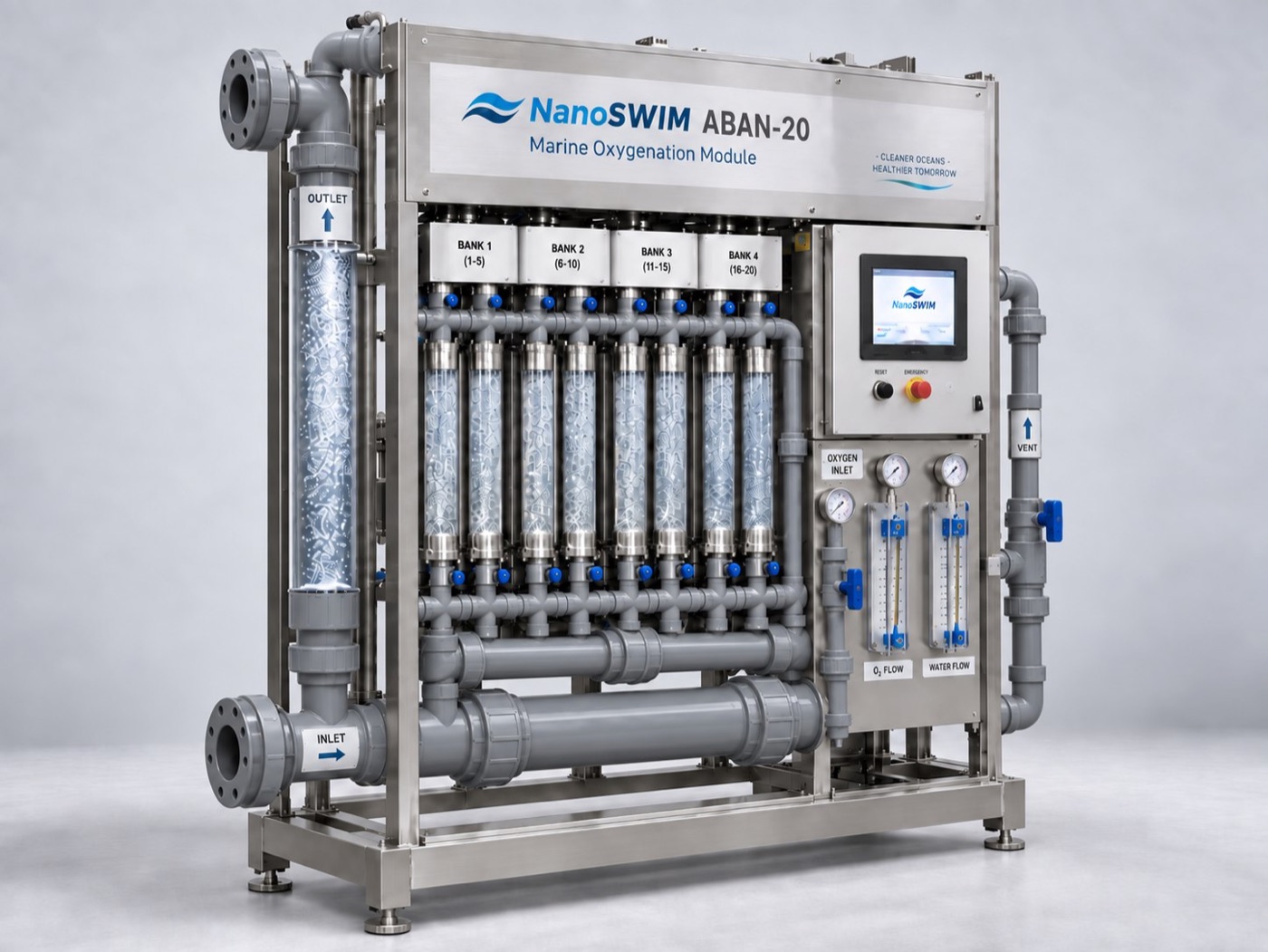
NanoSWIM ABAN-20
Nanobubble oxygenation for wellboats — 20 passive generators on one compact skid.
Sizing a nanobubble generator comes down to three questions, in this order. Everything else follows from them.
What is your circulation flow rate? This is the hard constraint. The generator sits inline in the circulation loop, so it has to match the flow your pumps already move. Flow rate — not pool volume — is what decides the model.
What are you treating? Pool water, transfer and distribution water, and industrial process water place different demands on materials and on how the gas is dosed.
Where does it have to go? A plant room with space and a permanent power supply is a different problem from a remote site or a temporary installation.
If you only know your pool volume and turnover time, that is enough — send it over and we will work the flow rate out with you.
For swimming pools and aquatic facilities
Two systems cover pools. Both do the same job; the difference is capacity and build.
The NanoSWIM Pool System is the standard choice for pools up to its rated volume, built in SS 304. The NanoSWIM Pro takes the same technology to a higher flow rate in SS 316L, which is the sensible specification for commercial and municipal facilities where bather load is heavy and the plant runs continuously.
For what this actually changes in the water — chemical consumption, air quality in the hall, clarity — see swimming pool water treatment. If you are still deciding whether to move away from chlorine at all, start with the buyer’s guide on chlorine-free pools.
For water transfer, distribution and industry
The NanoOzone Transfer Water system is built for transfer and distribution water, where the job is high-efficiency ozone dosing rather than continuous pool circulation. It is specified in SS 316L for the more aggressive duty.
The NanoSWIM Industrial system is the heavy-duty end of the range, configured per site rather than sold as a fixed package — because industrial water is never standard. Applications are covered on municipal and industrial water treatment.
For small, compact and temporary installations
The NanoSWIM Compact Unit is the plug-and-play option for spas, small pools and mid-scale installations where plant-room space is tight and a full engineering project is not warranted.
The NanoSWIM Mobile is trailer-mounted with quick-connect fittings, for remote sites, temporary installations, trials and emergency deployment. It is the right answer when the water needs treating but the site will not exist in six months.
For wellboats: the marine line
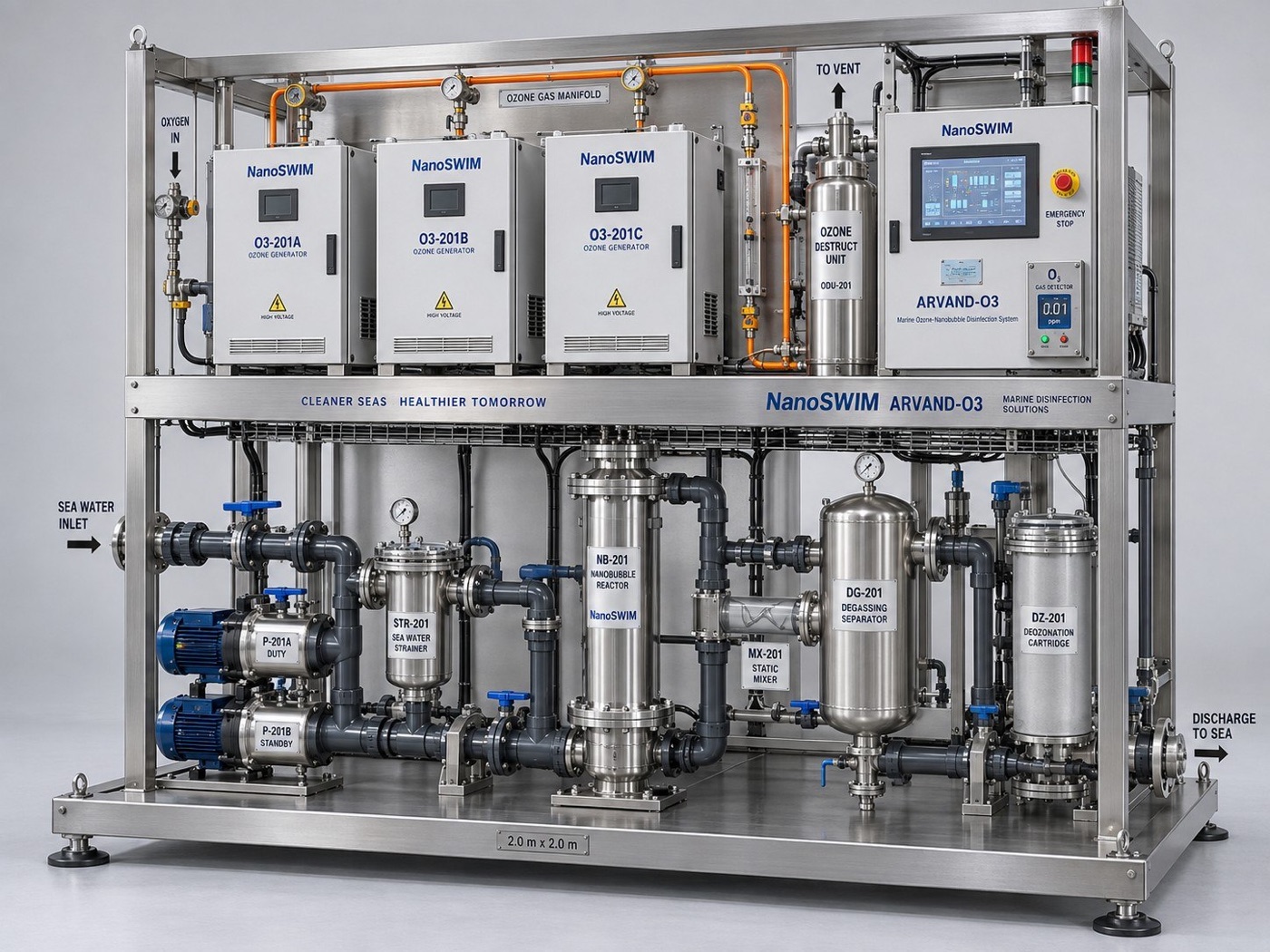
Two further systems are built for wellboats and sit outside the six above, because they solve vessel problems rather than plant-room ones. The ABAN-20 is a skid-mounted oxygenation module with 20 passive, hydrodynamic nanobubble generators. It treats a sidestream using the vessel's own seawater pump and oxygen supply, with a design basis of 1,000 m³/h and 100 kg O₂/h per module. The ARVAND-O3 is an ozone-nanobubble skid for closed-loop disinfection of the empty wells, piping and equipment between assignments, sized per vessel.
Both are offered through a pilot programme, and neither appears in the table below, which covers the six pool and water systems. How the two fit together on one vessel is explained on wellboat oxygenation and disinfection.
Figures are the rated maximums for each system. Actual sizing depends on your circulation flow, water temperature, bather or process load and turnover requirement — ask us for a figure against your own numbers rather than reading one off this table.
What every system shares
The differences above are about duty and scale. Everything below is common to the six pool and water systems; the wellboat skids are described on their own pages.
The same nanobubble generation. Sub-200 nm bubbles, high gas-transfer efficiency, oxidation without chemical dosing. The physics is explained on how nanobubbles work.
Inline installation after filtration. No separate contact tank. In a retrofit the basin, pipework and filter normally stay exactly as they are.
Oxygen or ozone. The gas is chosen for the job — oxygen where the goal is oxygenation, ozone where the goal is oxidation and disinfection.
Continuous, modest power draw. Worth asking for the kW figure at your flow rate and multiplying by your own tariff.
Before you ask for a quote
Four numbers let us give you a real answer instead of a brochure: water volume, circulation flow rate (or turnover time), whether the installation is indoor or outdoor, and your current treatment and chemical spend. With those we can tell you which model fits, whether it is a straightforward retrofit, and — occasionally — that it is not worth it for your facility.