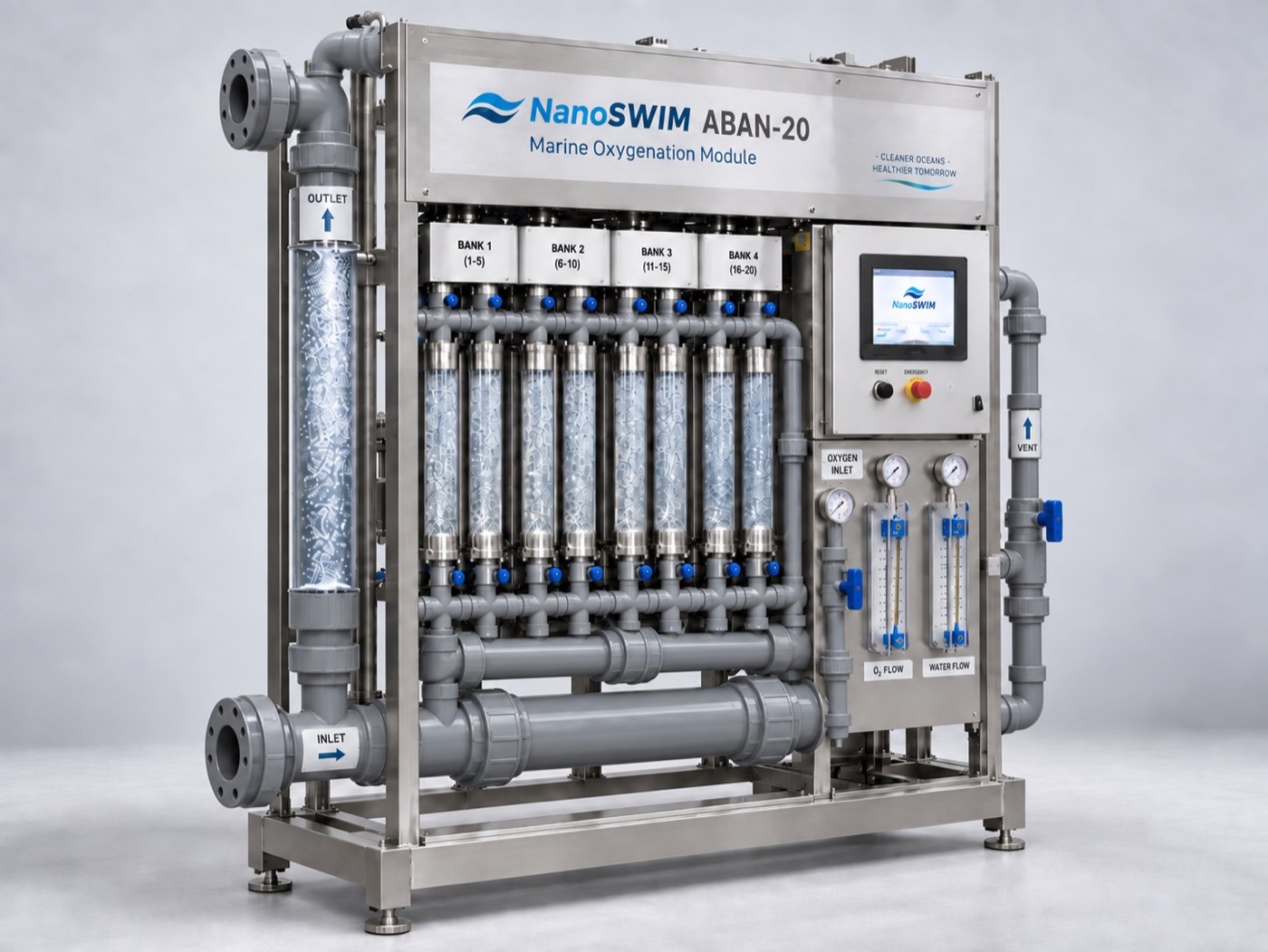
NanoSWIM ABAN-20 Wellboat Oxygenation Module
Nanobubble oxygenation for wellboats — 20 passive generators on one compact skid.
- No electrical power used inside the nanobubble generators
- Uses the vessel's existing seawater pump
- One module per well, 1.5 × 0.6 × 2.0 m
- Membrane-ready for later polishing or disinfection
Technical Specifications
| Generators | 20, in 4 banks of 5 |
|---|---|
| Generator type | Passive, hydrodynamic — no electrical power used inside the generators |
| Per generator | 50 m³/h and 5 kg O₂/h |
| Per module | 1,000 m³/h and 100 kg O₂/h |
| Hydraulic design ratio | 10 m³/h per kg O₂/h |
| Dimensions (L × W × H) | 1.5 m × 0.6 m × 2.0 m |
| Frame | Stainless steel |
| Piping and manifolds | PVC / UPVC |
| Pump | Not included — the vessel's seawater pump is used |
| Oxygen | Low-pressure oxygen from the vessel's oxygen supply |
| Electrical load | Controls and instrumentation only, approx. 1.5–3 kW |
| Control | PLC with HMI |
| Installation | One module per well recommended (distribution and redundancy) |
| Warranty | 2 years |
| Delivery | 3 months (as offered) |
| Basis of figures | Design basis — on-board performance is what the pilot programme is for |
How It Works
-
1
Take a sidestream
The vessel's own seawater pump sends a sidestream from the recirculation loop through the skid. The full well flow is not treated, and no pump is added.
-
2
Add oxygen, make nanobubbles
Low-pressure oxygen from the vessel's supply is fed in where mixing is strongest. Twenty passive hydrodynamic generators turn it into nanobubbles, with no electrical power used inside them.
-
3
Return it to the well
The oxygen-rich water goes back to the well. Flow meters for water and oxygen, and pressure gauges either side of the generator banks, show what the skid is doing.
You May Also Like
What is the ABAN-20 for?
The ABAN-20 is NanoSWIM's module for wellboat oxygenation: a skid with 20 integrated nanobubble generators that dissolves oxygen into a sidestream of seawater and sends it back to the well. It is built for the part of a wellboat's work where oxygen is hardest to manage — fish on board, during loading, transport and unloading.
The problems it is designed around are the ones wellboat crews already know. Oxygen demand changes quickly as fish are loaded, carried and pumped out. Fish welfare drops fast if dissolved oxygen becomes unstable. Space for a retrofit is limited, hydraulic capacity and pressure drop have to stay manageable, and operators want an operating cost they can predict and maintenance that stays simple.
The wider picture — oxygenation during transport and disinfection between assignments as two separate jobs on the same vessel — is on wellboat solutions. The fish-side background is on live fish transport.
How does wellboat oxygenation with the ABAN-20 work?
The design philosophy is simple: treat a sidestream, not the full well flow; keep the pressure low; keep the hydraulic demand low; keep the skid compact enough to retrofit. It works in four steps:
- A sidestream of seawater is taken from the vessel's recirculation loop, using the vessel's own seawater pump. No pump is included in NanoSWIM's scope.
- Low-pressure oxygen from the vessel's oxygen supply is fed in at the point where mixing is strongest.
- The passive hydrodynamic generators create the nanobubbles. No electrical power is used inside the generators to do it.
- Oxygen-rich water returns to the well.
The only electrical load is the controls and instrumentation, approximately 1.5–3 kW. Why gas held as nanobubbles behaves differently from ordinary bubbles is explained on the nanobubble technology.
How does the module fit on board?
The skid measures 1.5 m × 0.6 m × 2.0 m (L × W × H), on a stainless-steel frame with PVC / UPVC piping and manifolds. It connects to three things the vessel already has: the recirculation loop, a seawater pump with capacity for the sidestream, and the oxygen supply. A PLC with HMI runs it.
The instrumentation is on the skid itself, so the crew can see what it is doing without opening anything up:
- inlet isolation valve
- water flow meter and oxygen flow meter
- pressure gauges before and after the generator banks
- outlet riser / vent
- sample and sensor points
The module is membrane-ready: an optional sidestream membrane polishing or disinfection module can be added later without changing the core oxygenation skid.
Why one module per well?
Each ABAN-20 is rated at 1,000 m³/h and 100 kg O₂/h on its design basis, built up from 20 generators at 50 m³/h and 5 kg O₂/h each. The hydraulic design ratio is 10 m³/h of sidestream per kg O₂/h. On a multi-well vessel, NanoSWIM recommends one ABAN-20 per well, all fed from a common vessel oxygen header. The reason is distribution and redundancy, not capacity: every well has its own oxygenation skid, and a fault on one skid leaves the other wells supplied.
A worked sizing example shows the margin. It is a calculation from oxygen-demand models for salmon and cod, not a measurement. Two-well vessel, 2 × 1,500 m³, maximum stocking density 150 kg/m³ (225,000 kg of fish per well), water at 8 °C:
- Salmon, 1 kg: 142.4 mg O₂ per kg per hour → 32.05 kg O₂/h per well → 320.5 m³/h sidestream. One ABAN-20.
- Salmon, 5 kg: 103.2 mg O₂ per kg per hour → 23.23 kg O₂/h per well → 232.3 m³/h sidestream. One ABAN-20.
- Cod, 1 kg and 5 kg: 49.3 mg O₂ per kg per hour → 11.09 kg O₂/h per well → 110.9 m³/h sidestream. One ABAN-20. (The cod model has no weight term, so both sizes give the same figure.)
Models used: salmon O₂ = 82.9 × W^−0.2 × 1.07^T; cod O₂ = 80.1 × (1 − e^(−0.185 × T^0.79)), both in mg O₂ per kg fish per hour. Even the most demanding case, 1 kg salmon at 32.05 kg O₂/h, sits well inside one module's 100 kg O₂/h.
What the figures are — and what they are not
Being plain about the status: the flow and oxygen ratings above are the design basis of the module. The bubble measurements below are NanoSWIM internal tests. NanoSWIM has built a prototype and tested it in the laboratory, and the wellboat systems are offered through a pilot programme — which is where on-board performance gets measured. We do not claim a vessel is already running one.
In NanoSWIM's internal tests, nanoparticle tracking analysis gave mean bubble sizes of about 100–122 nm and concentrations in the order of 10⁸ particles per millilitre. Those numbers describe the bubbles. They are not a measurement of oxygen transfer on a vessel, and they say nothing about growth or mortality.
- It does not disinfect. Oxygenation with fish on board and disinfection of empty wells between assignments are different jobs. The disinfection side is NanoSWIM ARVAND-O3.
- It does not produce oxygen. It dissolves the oxygen the vessel already carries, from its existing supply.
- It depends on the vessel's pump. If the seawater pump has no spare capacity for the sidestream, that has to be solved first.
| Test | Mean | Mode | D50 | D90 | Concentration |
|---|---|---|---|---|---|
| Test A | 100.3 nm | 81.2 nm | 91.1 nm | 145.5 nm | 1.60 × 10⁸ particles/mL |
| Test B | 104.4 nm | 74.3 nm | 91.0 nm | 147.6 nm | 1.47 × 10⁸ particles/mL |
| Test C | 121.9 nm | 81.9 nm | 111.2 nm | 183.8 nm | 7.58 × 10⁷ particles/mL |
NanoSWIM internal measurements, not independent tests and not measured on board a vessel. D50 is the median bubble size; D90 is the size that nine in ten counted bubbles fall below.
What we need to size it for your vessel
The worked example above is the same calculation we would run on your vessel. To do it properly we need: the number of wells and their volume, the species and fish size you carry, the maximum stocking density, the water temperature range, and what you know about the recirculation loop, seawater pump capacity and oxygen supply.
With those we can tell you the oxygen demand per well, the sidestream it needs, and whether the ABAN-20 fits your vessel — or whether it does not. Talk to us about a pilot.
Frequently asked questions
How many ABAN-20 modules does a wellboat need?
Does the ABAN-20 need its own pump?
Does the ABAN-20 use electricity to make the nanobubbles?
Has the ABAN-20 been tested on a wellboat?
What bubble size does the ABAN-20 produce?
Can the ABAN-20 also disinfect the wells?
How much space does the ABAN-20 take on a wellboat?
Related pages
Size an ABAN-20 for your wellboat
Send us the number of wells, well volume, species, fish size, stocking density and water temperature. We will work through the oxygen demand per well with you and say plainly whether the ABAN-20 fits.