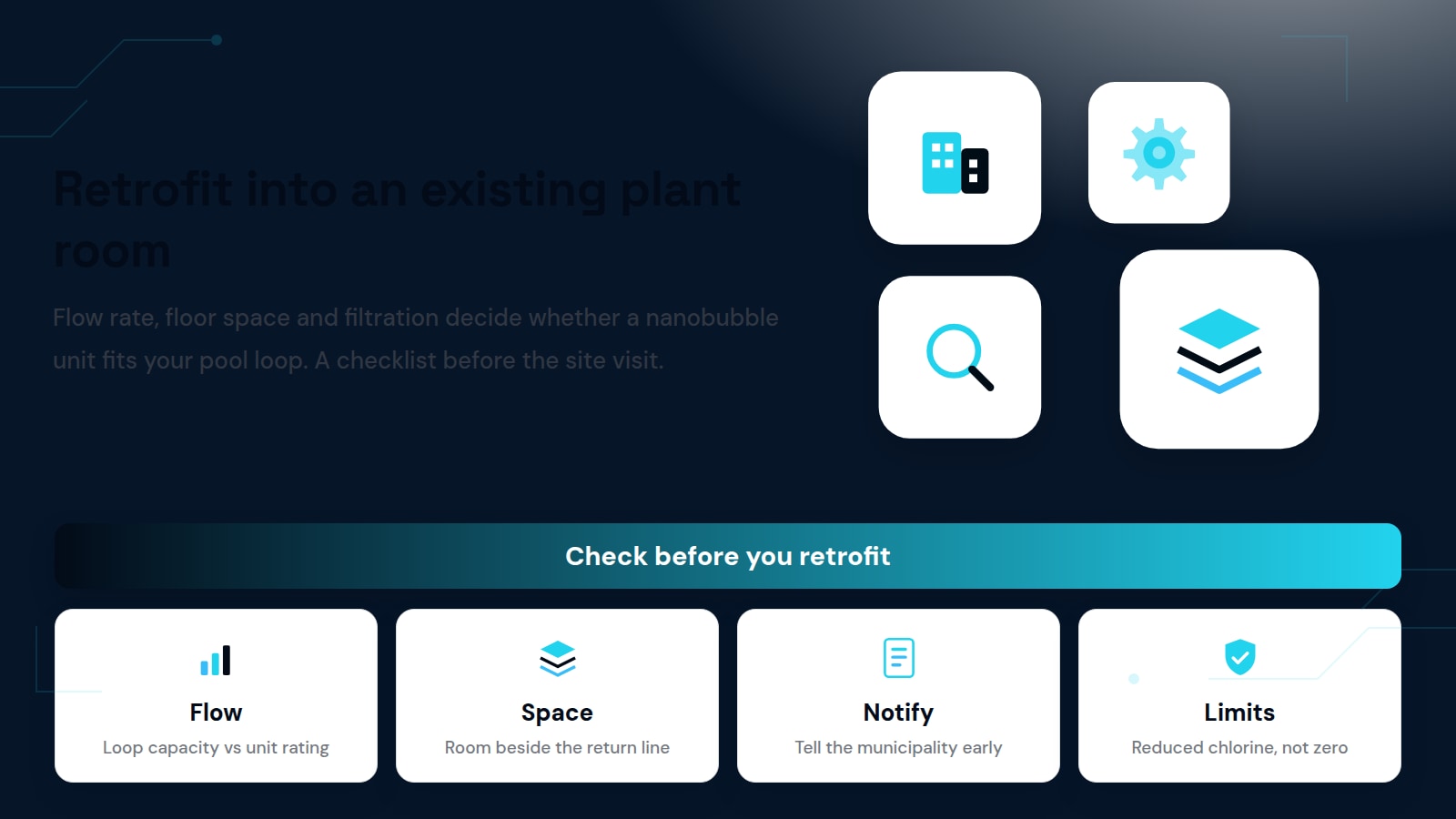
Yes, you can retrofit water treatment into an existing plant room, and the technology is rarely what stops you. Flow rate and floor space are. A nanobubble unit goes inline in the circulation loop after filtration, so the question is whether your loop has the flow, the pipe run and the metres of free wall to take it.
What decides whether a retrofit fits?
Three things, in this order: how much water passes through the loop per hour, how much room there is around the return line after the filters, and whether the loop itself is in good shape. Power is the smallest of the three. A retrofit is also an operational change, so the owner has duties towards the municipality, covered further down.
NanoSWIM units are installed inline in the existing circulation loop, after filtration. There is no separate contact tank to find room for. That removes the biggest space problem of many other retrofits, but not all of them. You still need a straight enough stretch of pipe, access for service, and a place for the controls.
How do you check flow rate and space before asking for a quote?
Do this before the first call to any supplier. It takes an afternoon with the plant drawings and a tape measure.
| Check | What to find out | Why it matters |
|---|---|---|
| Circulation flow | Design flow of the loop in m³/h, and what the flow meter actually reads | Each unit is rated for a maximum flow. Above it you need a larger unit or a split |
| Pool volume | Water volume per basin, including balance tank | Units are specified against both flow and volume |
| Position | The return pipe after the filters and before the pool | The unit sits after filtration, so this is where it must fit |
| Floor and wall space | Free area and service clearance beside that pipe | Often tighter than the drawings suggest |
| Filtration | Condition of filters, media and backwash routine | Treatment does not make up for poor filtration |
| Documentation | Current logging of flow, pH and disinfectant | Your municipality will ask for it after any change |
Which unit matches which loop?
The published ratings are the starting point. The NanoSWIM Compact Unit handles up to 60 m³/h and volumes up to 500 m³ and is plug and play. The NanoSWIM Pool System takes up to 500 m³/h, and the NanoSWIM Pro up to 800 m³/h. For very large or unusual sites the NanoSWIM Industrial is configured per site, up to 2,000 m³/h. See all of them on the products page.
A rating is not a promise for your plant. Confirm it on a site visit, with your real flow readings in hand.
What does a retrofit not solve?
This is where honesty saves time. Nanobubble treatment acts on water passing through the loop, like UV or ozone injection. It leaves no persistent residual in the basin by itself. It does not replace correct filtration, sensible pH control or competent operation.
If the filters are worn out, the balance tank is stagnant or the circulation is undersized for the bather load, adding a treatment unit moves the problem rather than removing it. Fix those first, or at the same time.
There is also a regulatory limit. A Norwegian public pool must keep disinfectant in the water at all times. Under forskrift for badeanlegg, bassengbad og badstu m.v. § 15, disinfectant must be present throughout the circulation system, and for chlorine the regulation sets a minimum free chlorine level that depends on water temperature. So in a public pool the realistic outcome is strongly reduced chlorine, not zero. Private pools, hotel pools and spas can run genuinely chlorine-free; see the chlorine-free pool option. The same logic is in the comparison with conventional chlorine.
Finally, capital cost is higher than dosing pumps and drums. NanoSWIM publishes no prices. Ask for a figure against your own pool volume, and weigh it against your chemical spend, not against nothing.
Do you have to tell the municipality about a retrofit?
Almost certainly. Under § 6 of the same regulation, the owner must notify the municipality before a facility opens and whenever operation changes, with an assessment of anything that could affect health, hygiene or safety. Bergen kommune describes the duty as notifying at start-up and at significant changes in operation. Whether a given retrofit counts as significant is the municipality's call, so ask early. Responsibility for water quality stays with the owner; FHI's water hygiene handbook says so plainly.
Keep your logging of flow, pH and disinfectant in order before and after. That is the evidence that the change did what you said it would. See also standards and documentation.
What should you prepare for the site visit?
- Plant drawings and a photo of the return line after the filters.
- Flow meter readings over a normal week, not only the design figure.
- Pool and balance tank volumes.
- Your current disinfectant and pH logs.
- The last inspection report from the municipality.
- A note of what you want to change: chemical use, smell, ventilation load, or all three.
With that, a befaring can answer fit and flow in one visit. Without it, expect a second one. You can contact NanoSWIM in Bergen to arrange it.
When is a retrofit the wrong answer?
When the plant room is being rebuilt anyway, plan the treatment into the new layout instead. When the loop is far beyond the largest published rating, expect a custom configuration. And when the real problem is bather load or air handling, treatment alone will not fix it.
Frequently asked questions
Can NanoSWIM be installed in an existing Norwegian pool plant room?
Yes in most cases. NanoSWIM units are installed inline in the existing circulation loop after filtration, with no separate contact tank. Fit depends on circulation flow, free space beside the return line and the state of the filters, and is confirmed on a site visit.
Does a retrofit let a Norwegian public pool stop using chlorine?
Not completely. A Norwegian public pool must generally keep a measurable disinfectant residual, so NanoSWIM's realistic outcome there is strongly reduced chlorine, not zero. Private pools, hotel pools and spas can run chlorine-free.
Do I need to notify the municipality before retrofitting a pool?
Under § 6 of the Norwegian forskrift for badeanlegg, the owner notifies the municipality when operation changes. Check with your kommune whether your retrofit counts as a significant change before work starts.
What did I learn from retrofits I have been part of?
In my own experience, the technology is never the hard bit. It is the plant room. On a job I worked on myself, we spent far longer looking for a spot where a technician could actually stand to service the unit than we did talking about bubbles. The drawings said there was space. There was, if you ignored the pipe someone had added years earlier and the door that only opened half way. Now I always ask to see the room first, with the lights on and a torch in my pocket. Funny how much a quick look behind the filters tells you.
Sources
- Forskrift for badeanlegg, bassengbad og badstu m.v. (FOR-1996-06-13-592) — Lovdata / Helse- og omsorgsdepartementet
- Meldeplikt for badeanlegg — Bergen kommune
- Vannhygiene – håndbok for helsepersonell — Folkehelseinstituttet