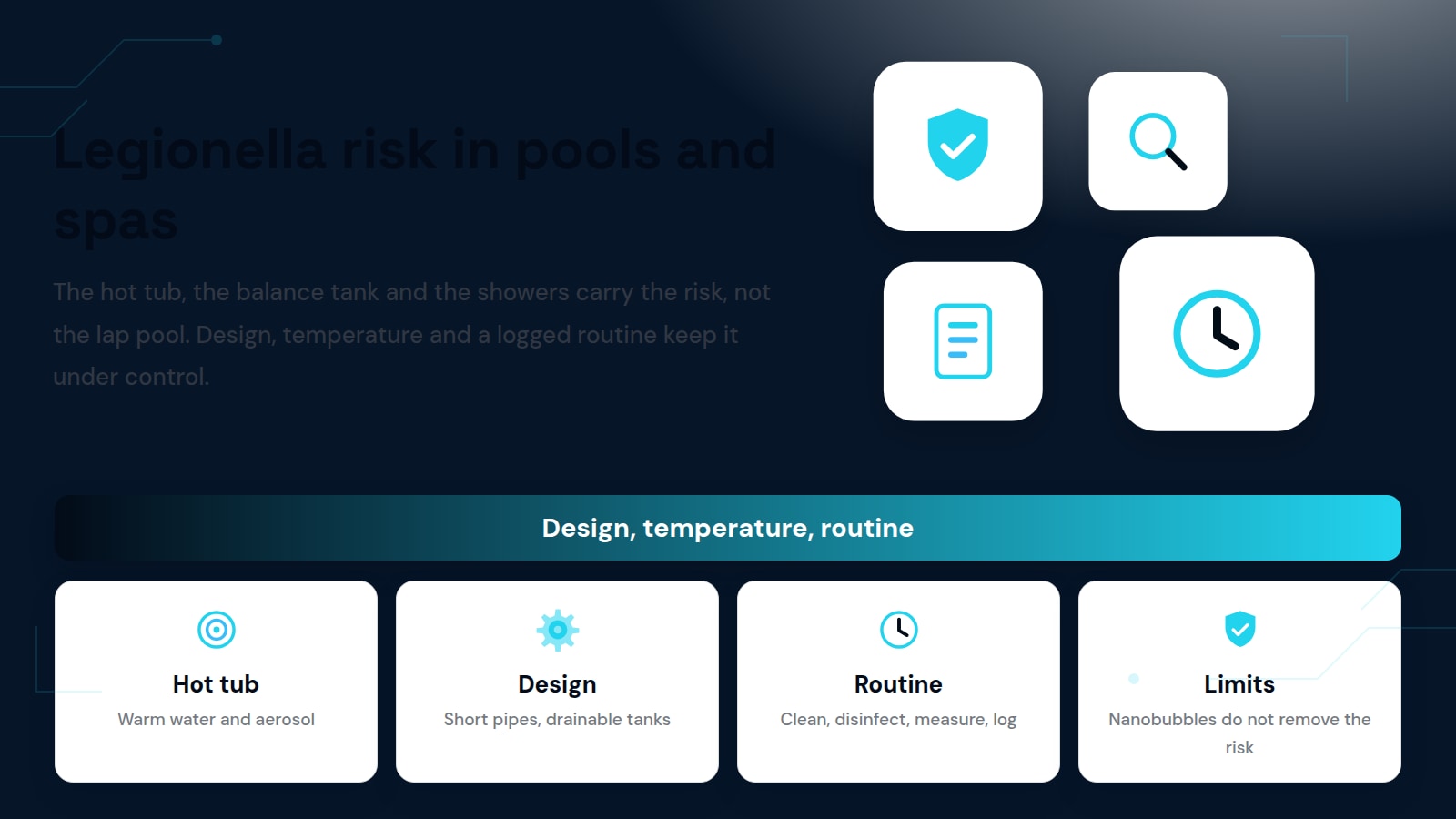
Legionella risk in pools and spas is managed by three things working together: how the installation is built, what temperature the water sits at, and whether the maintenance regime is followed and logged. No disinfection method does the job alone. The swimming basin is rarely the weak point. The hot tub is, along with the showers and every pipe where warm water stands still.
Where does legionella actually grow in a pool facility?
Folkehelseinstituttet (FHI) names cooling towers, shower systems and hot tubs as the most important sources of infection in Norway. According to FHI the bacteria grow best between 20 and 50 °C and do not establish themselves in water systems kept above 60 °C. Infection happens when someone breathes in fine droplets. It does not pass from person to person.
Put those facts next to a floor plan and the risk map draws itself. A cool, well-circulated lap pool produces little aerosol and sits at the low end of the growth range. A hot tub is the opposite. Helsedirektoratet's legionella guide points out that the bacteria thrive at 35–40 °C, which is where a hot tub normally runs, and that the jets and air blowers turn that water into droplets at face height.
| Part of the facility | Why it matters for legionella | What controls it |
|---|---|---|
| Swimming basin | Cooler water, little aerosol, continuous disinfection | Normal operation under the pool regulation |
| Hot tub (boblebad) | Warm water, heavy aerosol, small volume per bather | Design, short turnover, high disinfectant level, water replacement |
| Balance tank and air lines | Hidden surfaces where biofilm settles | Draining, cleaning and disinfection on a schedule |
| Showers | Warm supply water, taps unused for days | Hot-water temperature, flushing, cleaning of heads and hoses |
| Water features and fountains | Aerosol from water that may sit still when switched off | Included in the risk assessment, cleaned like the rest |
Why is a hot tub so much riskier than the pool beside it?
Volume and temperature. A handful of bathers in a small body of warm water load it far harder than the same people in a large basin, and the water is not changed between users. Helsedirektoratet adds a point many operators miss: the risk is there even when nobody is in the tub, because bacteria can spread from the surface and multiply in pipework and tanks where water stands.
What does Helsedirektoratet expect from a hot tub operator?
The hot tub chapter of the legionella guide is concrete. These are Helsedirektoratet's recommendations for publicly accessible hot tubs, not NanoSWIM's:
- Total water volume, tub plus balance tank, of at least 250 litres per bather.
- A circulation time through the filter of no more than 6 minutes.
- Sand filters, backwashed daily. Paper and polyester cartridge filters are discouraged.
- At least 50% of the water replaced every day.
- An automatic, continuously running disinfection system. Where chlorine is used, free chlorine of 3–4 mg/l.
- pH and disinfectant measured before opening and every second hour in use.
- Legionella analyses four times a year, and immediate closure on a positive result.
The pool regulation backs this up. Under forskrift for badeanlegg, bassengbad og badstu m.v., § 8 requires that growth and spread of legionella be prevented, and § 18 says every hot tub must be designed and run so that hygienic problems are avoided. A tub model that has not been assessed in advance is assessed individually by the municipality. The regulation does not apply to hot tubs in private homes, though the biology is the same there.
Which design choices decide the risk before the tub is filled?
Most of the legionella work is done, or made impossible, on the drawing board. Helsedirektoratet asks for short pipe runs, as little stagnant water as possible, and no corrugated hoses, because their surface gives biofilm more to hold on to. Pipes should be removable for inspection. The balance tank and the air system should drain completely.
If you are buying a hot tub for a hotel spa or a municipal facility, ask the supplier to show you how each of those is done on the actual unit. A tub where the air channel under the seats cannot be opened or drained will be hard to keep clean, however good the water treatment is.
Is disinfection enough to keep legionella away?
No. Helsedirektoratet's chapter on water treatment methods goes through heat, chlorine, chlorine dioxide, ozone, UV and others, and presents none of them as sufficient alone. Chlorine does not work in stagnant water or dead legs. UV leaves no residual effect downstream of the lamp. Ozone is a strong disinfectant, but the guide notes that its effect is short-lived and fades along the pipe. Cleaning comes before disinfection in every case, because disinfectant has trouble reaching bacteria that sit inside biofilm.
The practical order is: remove the places where water stands, keep surfaces clean, then disinfect, then measure.
Can nanobubble treatment remove the legionella risk?
No, and NanoSWIM does not claim it. Our systems are treatment-loop technology, installed inline in the circulation after filtration. They act on the water that passes through them, in the same way UV and conventional ozone injection do, and they leave no persistent residual in the basin. NanoSWIM publishes a figure of 99.9% pathogen reduction for oxidative disinfection in the treatment loop. That figure describes water going through the unit. It says nothing about an air line under a hot tub seat, a balance tank that is never drained, or a shower hose in the changing room.
What the technology does contribute is on the cleaning side. Nanobubbles carry a negative surface charge that helps lift fine particles and biofilm off wetted surfaces in the loop, which makes the filter's job easier. That supports a legionella regime. It does not replace one, and we have no test result that would let us say more.
A publicly accessible facility in Norway still needs a measurable disinfectant in the water, so the realistic outcome in a public pool is strongly reduced chlorine, not zero. For a hotel spa with a hot tub, settle the disinfection concept with the municipality before you change anything.
What should the risk assessment and the log contain?
A legionella risk assessment for a pool facility that only covers the basin is not finished. It should list every point where warm water meets air, say who is responsible for each one, and state what is measured and how often. The operating log then shows that it happened: pH and disinfectant readings, backwash, water replacement, cleaning of the balance tank and air system, sampling dates and results, and what was done after a deviation.
Ask any supplier of water treatment, NanoSWIM included, what their equipment logs and how that record fits into your internal control. Our page on standards and documentation covers what to ask for. If you want to go through your own plant, contact NanoSWIM in Bergen and bring the log.
Frequently asked questions
Does NanoSWIM eliminate legionella in pools and spas?
No. NanoSWIM's nanobubble treatment acts on water in the circulation loop and leaves no persistent residual in the basin. Legionella risk in a Norwegian pool or spa is managed by design, temperature control, cleaning, disinfection and a documented maintenance regime, and NanoSWIM does not replace any of them.
Why are hot tubs a higher legionella risk than swimming pools?
Hot tubs run at temperatures where legionella grows well, hold little water per bather and throw up aerosol from jets and air blowers. Helsedirektoratet in Norway therefore sets separate recommendations for hot tubs, including short circulation time, daily water replacement and legionella analyses four times a year.
What does Norwegian regulation say about legionella in pool facilities?
The Norwegian forskrift for badeanlegg, bassengbad og badstu requires in § 8 that growth and spread of legionella be prevented, and in § 18 that hot tubs be designed and run so hygienic problems are avoided. The municipality supervises, and Helsedirektoratet's legionella guide describes how to comply.
What do I look at first when legionella comes up?
In my own experience, Norwegian operators bring up documentation and logging long before they ask me anything about the equipment. I used to think that was just caution. Now I think it's the right instinct, and with legionella it's the whole game. When I visit a facility I ask to see the hot tub log before I look at a single pump, and honestly, the binder tells me more than the plant room does. If the pages for the quiet weekdays are as filled in as the busy weekends, I relax a bit. If someone has to go and look for it, I know what we'll be talking about for the next hour.
Sources
- Forskrift for badeanlegg, bassengbad og badstu m.v. (FOR-1996-06-13-592) — Lovdata / Helse- og omsorgsdepartementet
- Legionella, veileder: Boblebad — Helsedirektoratet
- Legionella, veileder: Vannbehandlingsmetoder — Helsedirektoratet
- Legionellose – håndbok for helsepersonell — Folkehelseinstituttet