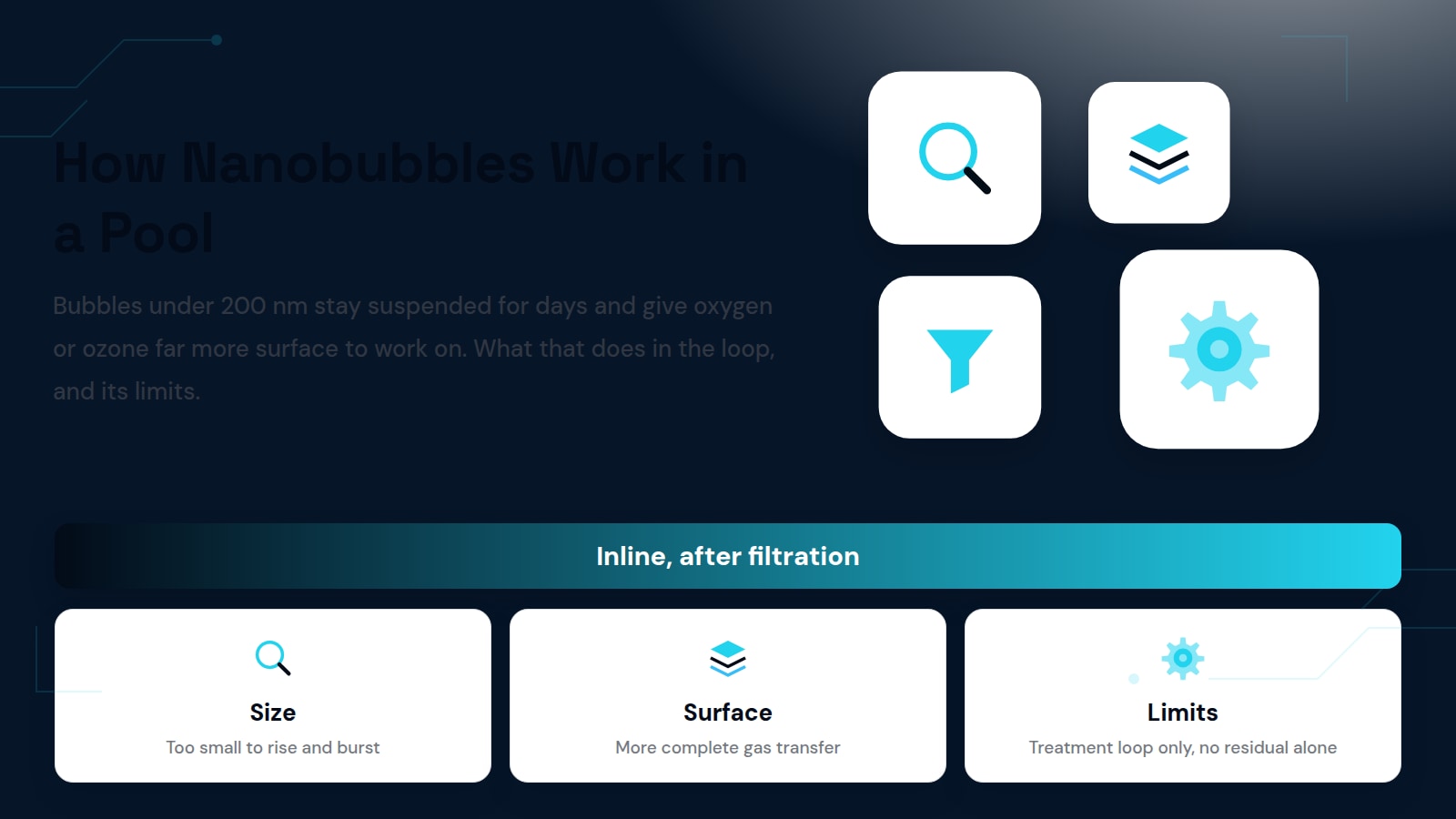
Nanobubbles work in a swimming pool by staying in the water. They are gas bubbles under roughly 200 nanometres across, so they do not rise and burst like the bubbles from a return jet. They stay suspended for days, and while they do, they give oxygen or ozone a far larger surface to react on than any coarse injection can. That is how nanobubble treatment disinfects and clears organic load in the circulation loop without a heavy chlorine dose.
What Are Nanobubbles in Pool Water?
Ordinary bubbles are big enough for buoyancy to win. They climb to the surface in seconds and the gas leaves with them. Below roughly 200 nanometres the balance changes: buoyancy stops dominating and the bubbles drift with the water instead of rising through it.
Two properties matter for a pool operator. First, the bubbles carry a negative surface charge. Like charges repel, so the bubbles do not merge into larger ones that would then float away. The same charge helps lift fine particles and biofilm off wetted surfaces. Second, the combined surface area of that many tiny bubbles is very large compared with the same volume of gas in coarse bubbles. Surface area is where gas transfers into water, so more of the gas ends up doing work and less escapes at the surface.
How Do Nanobubbles Disinfect a Pool?
The gas is either oxygen or ozone. Oxygen is used for oxygenation. Ozone is used for oxidation and disinfection, and it reverts to oxygen and leaves no residue.
When a nanobubble collapses it releases concentrated oxidative energy. This is advanced oxidation: it disrupts pathogens and breaks down the organic load that bathers bring into the water, such as skin cells, sweat and cosmetics. NanoSWIM's published figure is 99.9% pathogen reduction from oxidative disinfection in the treatment loop.
The organic load matters because it is what turns chlorine into chloramines, the compounds behind the sharp smell and stinging eyes that most people blame on too much chlorine. Less organic load reaching the chlorine means less chloramine forming. If you want the chemistry behind that, the technology page covers the mechanism in more depth.
Where Does the System Sit in the Pool Plant?
Inline, in the existing circulation loop, after filtration. There is no separate contact tank to build. Water leaves the pool, passes the filters, passes through the nanobubble unit and returns to the basin. For a pool of up to 50,000 L and a flow rate of up to 500 m³/h, that is the NanoSWIM Pool System. Larger pools or higher flow are a different product, so the right question for any site is volume and flow rate first.
Because the system is inline, it treats water that passes through it. That sounds obvious, but it is the most important limit to understand, and it comes up again below.
How Does It Compare With UV and Ozone Injection?
Buyers usually ask this before anything else. All three are treatment-loop technologies: they act on water in the plant room, not on the water in the basin.
| Question | UV | Coarse ozone injection | Nanobubble oxygen or ozone |
|---|---|---|---|
| Where does it act? | In the loop, under a lamp | In the loop, by injecting gas | In the loop, after filtration |
| Gas efficiency | Not applicable | Most of the gas escapes at the surface | Very large bubble surface area, more complete gas transfer |
| Persistent residual in the basin | No, on its own | No | No, on its own |
| Breaks down organic load | Limited to what passes the lamp | Yes, where the ozone reacts | Yes, through advanced oxidation |
For a straight side-by-side, see the comparison with UV and the comparison with ozone.
What Does Nanobubble Treatment Not Do?
This is the part a supplier page usually skips, so here it is plainly.
- It is not something you pour in. It is a treatment-loop technology, exactly like UV and ozone injection. Water has to pass through it.
- It leaves no persistent residual in the basin on its own. Between passes through the loop, nothing in the water is dosing against a new contaminant.
- A Norwegian public pool cannot go chlorine-free. Forskrift om badeanlegg, bassengbad og badstu, enforced by the municipal health authority, generally requires a measurable disinfectant residual. The realistic result is strongly reduced chlorine, not zero. Private pools, hotel pools and spas can run genuinely chlorine-free; see what a chlorine-free pool involves.
- It does not replace the basics. Correct filtration, sensible pH control and competent operation still decide whether the water is good.
- The capital cost is higher than dosing pumps and chemical drums. NanoSWIM publishes no prices, so the honest route is to give us your pool volume and flow rate and ask for a figure against your own site.
What Should You Check Before Considering It?
- Pool volume and circulation flow rate, and whether they fall inside a unit's rated capacity.
- Plant-room space and access to the circulation loop after the filters.
- Whether the pool is public (residual required) or private, hotel or spa.
- The condition of the filtration and pH control you already have. Nanobubbles will not rescue a poorly run plant.
- What documentation and operating logs the supplier can provide. NanoSWIM does not claim any certificate or approval, so ask every supplier, including us, exactly what they can document.
Against a conventional chlorine dosing regime on comparable pools, NanoSWIM's published figure is up to 90% less chemical use. The documented case is a 2,500 m² resort pool complex in southern Europe, where chlorine consumption fell by 85% and water-treatment operating cost by 60%. The client is not named, for commercial confidentiality, and the 60% is the treatment line, not the resort's total operating cost. More on where this fits is on the swimming pool application page.
In my own experience, operators notice the water before any test result does. I have stood in plant rooms with a driftsansvarlig who told me, half-way through a sentence about something else, that the water looked cleaner from the pool deck, and only afterwards pulled out the test kit to check. The kit agreed, but it always seemed to be second in line. I like that, because it means the people who run the pool every day trust their eyes, and they are usually right.
If you want to know whether this fits your pool, contact NanoSWIM in Bergen with your pool volume and flow rate, and we will tell you honestly whether it does.