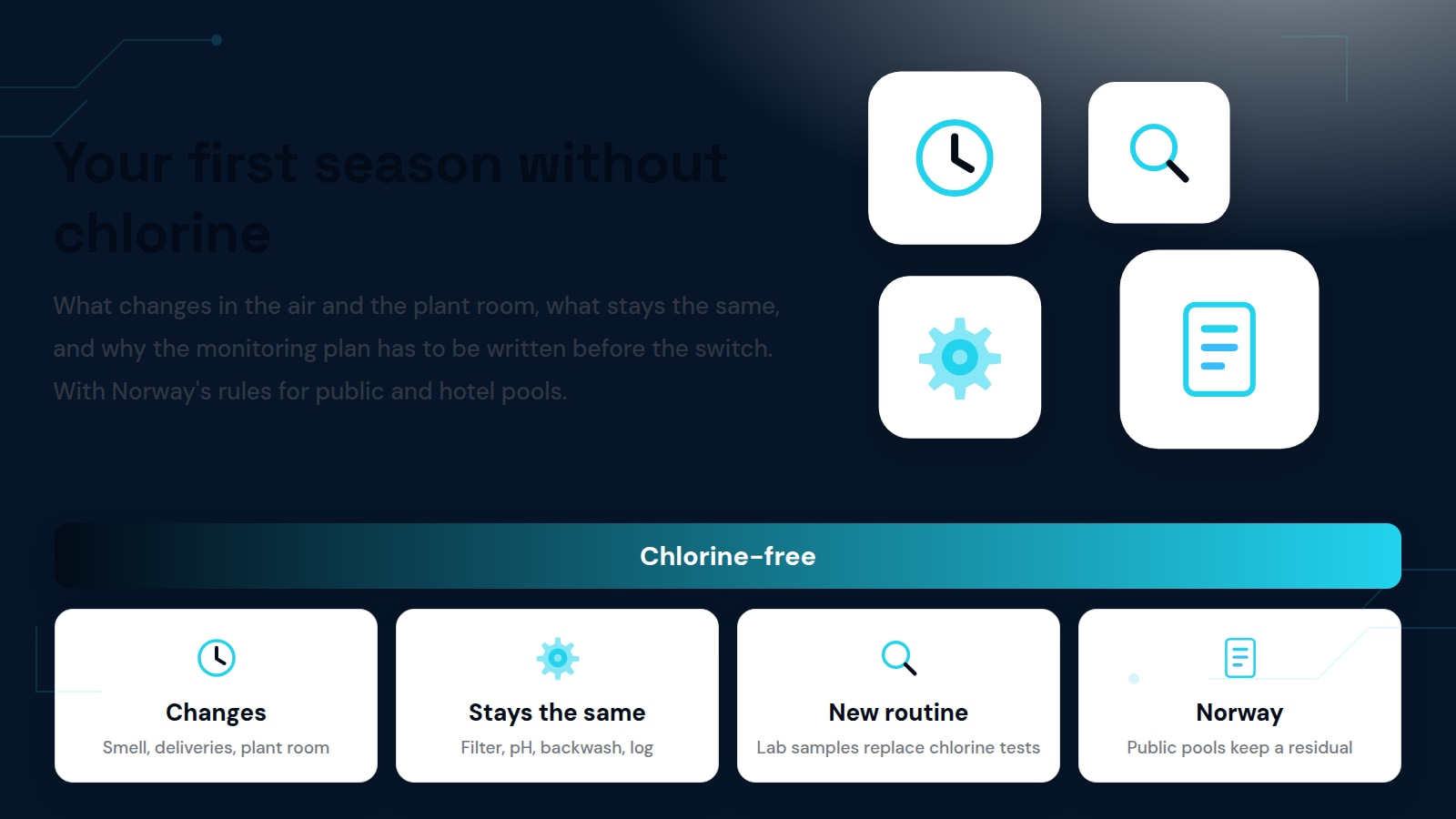
In the first season after going chlorine-free, the changes you notice first are in the air, the plant room and the delivery schedule. The things that stay the same are filtration, pH control, backwashing and the logbook. The biggest change is one most owners don't expect: how you prove the water is safe. With no free chlorine reading to fall back on, the monitoring plan has to be agreed before the switch, not worked out halfway through the season.
This article is for owners of private pools, hotel pools and spas who are considering a chlorine-free pool, and for facility managers who want to know what a first season actually looks like before they ask for a quote. It covers what changes, what does not, and where the first season tends to go wrong.
Can every pool go chlorine-free in the first place?
No, and that has to be settled before anything else. A Norwegian public pool operates under the forskrift for badeanlegg, bassengbad og badstu. Section 15 of that regulation is written around chlorine. It sets a minimum free chlorine level at the basin outlet, 0.4 mg/l for water up to 27 °C and higher for warmer water, and a ceiling of 0.5 mg/l for combined chlorine. So for a public pool the realistic first season is strongly reduced chlorine, not zero: nanobubble treatment carries most of the oxidative load and conventional dosing keeps the required residual.
The regulation applies to pools that are accessible to the public. A home pool falls outside it. A hotel pool is less clear-cut: one that sells day passes to non-guests is more likely to be covered than one used only by hotel guests. If you run a hotel pool, ask the municipal health authority before you plan a fully chlorine-free season. Section 6 also requires the owner of a covered facility to notify the municipality when operations change, and a switch of disinfection method counts.
What changes in the first weeks?
The smell goes first. That sharp "pool smell" comes from chloramines, which form when chlorine reacts with what bathers bring into the water. Take away the chlorine dosing and that source is gone, so the hall and the corridor outside it stop smelling of a swimming pool. Staff notice before guests do, because they spend whole shifts at the water's edge.
The plant room changes too. There are no drums of hypochlorite to receive, store and handle, and no dosing pump to prime. What is left is the circulation loop with the nanobubble unit installed inline after filtration, injecting oxygen or ozone as bubbles under roughly 200 nanometres. Ozone reverts to oxygen and leaves no residue in the water.
Operators often say the water looks different early on: clearer, with a sharper view of the floor. Treat that as an observation, not a test result. It is encouraging, but it proves nothing about microbiology.
What does not change at all?
More than most sales conversations admit. Nanobubble treatment is a treatment-loop technology. It acts on water passing through the plant room, the same way UV and ozone injection do. It does nothing for water that is not circulating, and it does not replace any of these:
- Filtration and a backwash routine that is actually followed.
- pH control. Scaling and corrosion are chemistry problems, and they stay.
- Circulation without dead zones. A corner the flow does not reach is still a problem.
- Showering before swimming. Less organic load in means less to oxidise.
- Competent operation by someone who reads the log.
Capital cost is also higher than a dosing pump and a stock of chemicals. Owners should weigh that against what they are trying to solve. If the only complaint is the cost of chlorine, the case is weaker than if the problem is corrosion, ventilation or staff complaining about the air.
How do you check the water without a chlorine reading?
This is where a first season succeeds or fails. On a chlorinated pool, a free chlorine reading of a few seconds tells you there is disinfectant in the basin. Nanobubble treatment leaves no persistent residual in the basin on its own, so a free chlorine test simply reads zero and tells you nothing. The monitoring has to be rebuilt around other measurements. That responsibility does not move to the supplier: as Folkehelseinstituttet puts it, owners of pools and hot tubs are responsible for keeping the water quality good.
The WHO guidelines for swimming pools treat microbial contamination and chemical exposure as two separate hazards, each needing its own control and monitoring. Removing the chemical side does not remove the microbial one.
The checklist below is the order we would work through with an owner. It applies to pools running genuinely chlorine-free. A public pool keeps its chlorine sampling under section 17 of the forskrift, which for heavily used pools means free and combined chlorine at least four times a day.
| When | What to do | Why it matters |
|---|---|---|
| Before the switch | Write the monitoring plan: what is measured, how often, by whom, and what triggers action | Without it, the first odd reading turns into guesswork |
| Before the switch | Take a baseline microbiological sample from an accredited laboratory | You need a "before" to compare the season against |
| First weeks | Log pH, temperature, clarity and the unit's own operating readings daily | Early drift in pH or flow shows up here first |
| First weeks | Expect leftover chemistry: existing chloramines and, in outdoor pools on stabilised chlorine, cyanuric acid | Stabiliser leaves mainly through dilution, so plan water exchange rather than waiting |
| Through the season | Repeat laboratory samples at agreed intervals, and after heavy-use periods | Microbiology is what actually confirms the water is safe |
| End of season | Review the log against the baseline with the supplier | Decides what to adjust for season two |
What tends to go wrong in the first season?
Three things come up again and again. The first is treating the new system as a reason to relax the routine: filter runs get longer, backwashing slips, and pH gets checked less often because "the water is fine". The second is no plan for the leftovers. Water that has been chlorinated for years does not reset on day one, and in an outdoor pool the stabiliser is still there until it is diluted out. The third is a busy period nobody planned for, such as a holiday week or a hotel at full occupancy, when organic load runs well above normal and the circulation hours stay where they were.
None of these is a fault in the technology. They are operational, and an honest supplier should raise them before installation.
What results are realistic to expect?
NanoSWIM's figure for chemical use is up to 90% less against a conventional chlorine dosing regime on comparable pools. That is a ceiling, not a promise for every installation. The documented example is a 2,500 m² resort pool complex in southern Europe, which recorded 85% less chlorine consumption and 60% lower water-treatment operating cost. That is the cost of water treatment, not the resort's total running cost. The client is not named for reasons of commercial confidentiality.
For a hotel considering this, our hotel pool page covers the practical setup. For the regulatory side in Norway, see standards and regulation. If you want a realistic picture for your own pool, send us the pool volume, flow rate and current treatment and we will tell you what we think a first season would look like.
What I have seen myself
In my own experience, the first person to say something is never the owner and never a swimmer. It's the instructor who stands in the shallow end through the afternoon lessons. A few weeks in they mention, almost in passing, that their throat isn't rough by the evening session any more, and that their towel doesn't smell of the pool when they get home. Honestly, that comment tells me more than the first lab result. And here in Norway, the owners who get through the first season without stress are the ones who asked me about logging and documentation in the very first meeting, before we'd even talked about the equipment.
Sources
- Forskrift for badeanlegg, bassengbad og badstu m.v. (FOR-1996-06-13-592) — Lovdata
- Vannhygiene – håndbok for helsepersonell — Folkehelseinstituttet
- Guidelines for safe recreational water environments. Volume 2: Swimming pools and similar environments — World Health Organization